
Introduction: The Dublin Patient's Dilemma
If you’ve picked up an injury running along the active paths of the Phoenix Park or woke up with severe neck stiffness after an intense week at your desk in the Silicon Docks, your immediate instinct might be to book a standard physical therapy appointment. But many patients reach a point where standard rehabilitation exercises aren’t moving the needle.
This brings up a massive, frequently asked question: What can osteopathy actually provide a patient that physiotherapy can't?
While both professions are exceptional at treating pain, their core philosophies, diagnostic lenses, and hands-on techniques differ dramatically. Understanding these differences is often the missing key to moving past chronic injury and reclaiming true fluid movement.
Osteopathic manual therapy focuses on global physical manipulation to restore structural symmetry.. Source: Albina Gavrilovic / Getty Images
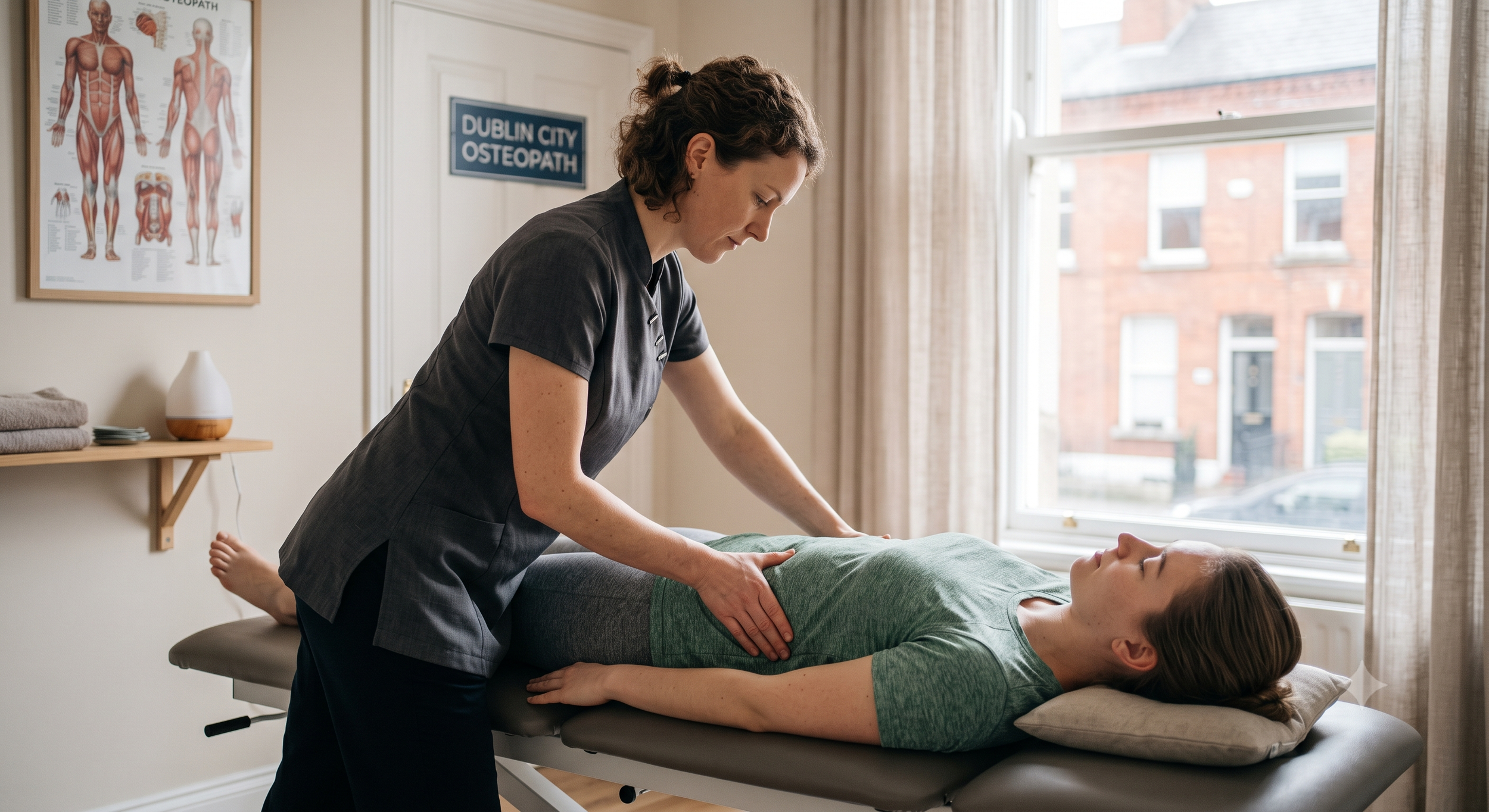
The Core Difference: Isolated Rehabilitation vs. Total Structural Unity
The simplest way to break down the contrast is looking at where the practitioner’s eyes go first.
Physiotherapy often operates on a localized, rehabilitative model. If your knee hurts, a physiotherapist will predominantly examine the knee joint, look at the surrounding quad and hamstring strength, and prescribe highly targeted exercises to stabilize that specific area.
Osteopathy, by contrast, is built on the principle that the body is an interconnected, self-healing ecosystem. An osteopath treats the host, not just the symptom. If you present with knee pain, an osteopath will carefully assess your pelvic alignment, the mechanics of your lower back, and even old ankle restrictions to discover why that knee is being forced to take an uneven mechanical load in the first place.
3 Things You Get from an Osteopath That You Won't Find in a Physio Clinic
1. Global Hands-On Manual Manipulation
While many modern physiotherapists lean heavily toward "hands-off" treatment pathways (relying mostly on exercise sheets, gym rehabilitation, and resistance bands), osteopaths maintain a deeply tactile, hands-on approach throughout your entire recovery cycle. Osteopathic care relies on highly specialized manual palpation, rhythmic joint mobilization, visceral manipulation, and myofascial release. We physically guide your restricted tissues back into alignment during the session, providing immediate neurological and mechanical relief that an exercise sheet simply cannot duplicate.
2. Optimization of Systemic Fluid Mechanics
Osteopathy doesn't just evaluate muscles and bones; it treats the integrated vascular and nervous networks. By physically releasing deep fascial restrictions around major arteries, veins, and lymphatic pathways, osteopathic treatment directly enhances systemic circulation and drainage. Improving fluid movement speeds up cellular repair, reduces chronic, sluggish inflammation, and lowers the hyper-tonicity (constant background tension) of an over-stimulated sympathetic nervous system.
3. Deep Integration of the Viscerosomatic Framework
Did you know that chronic tension in your mid-back can sometimes be linked to digestive stress, or that pelvic floor restrictions can alter your walking gait? Osteopaths are explicitly trained in viscerosomatic relationships—how your internal organs (viscera) share nerve pathways with your musculoskeletal structure. By identifying and treating these profound somatic connections, an osteopath can resolve deep, structural back and pelvic issues that local muscle rehabilitation completely overlooks.
Choosing the Right Path for Your Recovery
To help clarify which approach aligns best with your specific health goals, consider how the primary manual therapy disciplines contrast in their daily clinical practice:
DimensionOsteopathyPhysiotherapyChiropracticCore PhilosophyThe body is an interconnected system; structure dictates function.Focused heavily on local biomechanical function and targeted rehabilitation.Centers primarily on spinal alignment and nervous system flow.Primary MethodsGlobal soft tissue work, joint mobilization, gentle visceral release.Exercise prescription, localized electrotherapy, targeted stretching.High-velocity, low-amplitude spinal adjustments (joint cracking).Typical SessionHolistic, full-body assessments with prolonged manual contact.Short local assessment paired with guided gym or home exercises.Short, localized appointments heavily focused on spinal manipulation.
The Takeaway: If you have an isolated sports injury and require a structured gym rehab plan to rebuild specific muscle strength, a physiotherapist is a great fit. But if you are dealing with chronic, recurring pain, systemic stiffness, or an injury that feels like it’s throwing your entire alignment out of whack, a Dublin City Osteopath provides the comprehensive structural resolution your body is looking for.